

















This article is for educational purposes only and does not constitute financial advice. DeFi involves significant risks, from impermanent loss to smart contract vulnerabilities and potential total loss of funds. All data is accurate as of February 2026 and may change substantially. Do your own research (DYOR) before participating in any DeFi protocol.
My first swap on DeDust took 4 seconds and cost $0.03 in fees. After years of using Uniswap, where a single swap can eat $15–50 in gas, this felt like teleportation. TON DeFi does not have Ethereum's market cap ($300M TVL vs $50B+), but in terms of user experience and speed, it has already surpassed most competitors.
This guide covers the two largest DEXes on TON — DeDust and STON.fi — explains how liquidity provision works, and shows concrete earning strategies. Not abstract "consider your options" advice, but specific pools, real APY numbers, and the math behind the risks.
What Is DeFi on TON and Why It's Different
DeFi in 60 Seconds
DeFi (Decentralized Finance) refers to financial services that operate without banks or intermediaries. Instead of trusting an exchange with your funds, you interact directly with smart contracts: swap tokens, provide liquidity, earn yield — all through code, not through a manager.
Three core components of DeFi on any blockchain:
- DEX (Decentralized Exchanges) — token swaps without a middleman. On TON, this means DeDust and STON.fi
- Liquidity Provision — you deposit tokens into a pool so others can trade, and you earn a share of trading fees
- Staking — locking TON to support the network and earning yield
Why TON DeFi Is a Different Game
TON's architecture differs fundamentally from Ethereum, and this shapes the entire DeFi experience:
Speed. Transaction finality on TON is 3–5 seconds. On Ethereum, it takes 12–15 minutes for reliable confirmation. In DeFi, speed equals safety — the faster your swap executes, the less price slippage you face.
Fees. Average swap cost on TON: 0.01–0.05 TON ($0.03–$0.15). One Uniswap swap on Ethereum costs $5–50 depending on network congestion. On TON, you can execute 100 transactions for the price of one on Ethereum.
Sharding. TON is the only major blockchain with production-ready sharding. The network scales dynamically: more users means more shards processing transactions. Ethereum still hits its per-block gas limit.
Telegram Integration. DeFi protocols on TON are accessible through Telegram bots and Mini Apps. You can perform a swap without leaving your messenger. This radically lowers the barrier to entry.
The trade-off: the ecosystem is younger and smaller. Total TVL across all TON protocols is approximately $300M (February 2026). For comparison, Uniswap alone on Ethereum holds $5B+. Less liquidity means more slippage on large orders. Pools with niche tokens can be so shallow that a $500 swap moves the price 3–5%.
DeDust: The Largest DEX on TON
Overview
DeDust is a decentralized exchange built natively for the TON blockchain. TVL as of February 2026 is approximately $379M, making it the largest DeFi protocol on TON by pool liquidity. It offers over 600 liquidity pools and supports all Jetton tokens (the TON token standard).
Key features of DeDust:
- Multi-hop swaps — automatic routing through multiple pools for the best price. If there's no direct TON/DOGS pool, DeDust routes through TON/USDT → USDT/DOGS
- Stable swaps — specialized pools for stablecoins (USDT/USDC) with minimal slippage and reduced fees
- TON Connect — authentication via Tonkeeper, TON Space, or @Wallet — no seed phrases or browser extensions needed
- Cross-chain bridges — swaps between TON and Ethereum assets (WBTC, USDC, DAI)
How to Make Your First Swap on DeDust
Step-by-step:
- Open DeDust.io in your browser or via the Telegram Mini App
- Click "Connect Wallet" and select your wallet (I recommend Tonkeeper — best TON Connect support)
- Select the pair: for example, TON → USDT
- Enter the amount of TON to swap
- Review the exchange rate, slippage, and fee
- Confirm the transaction in your wallet
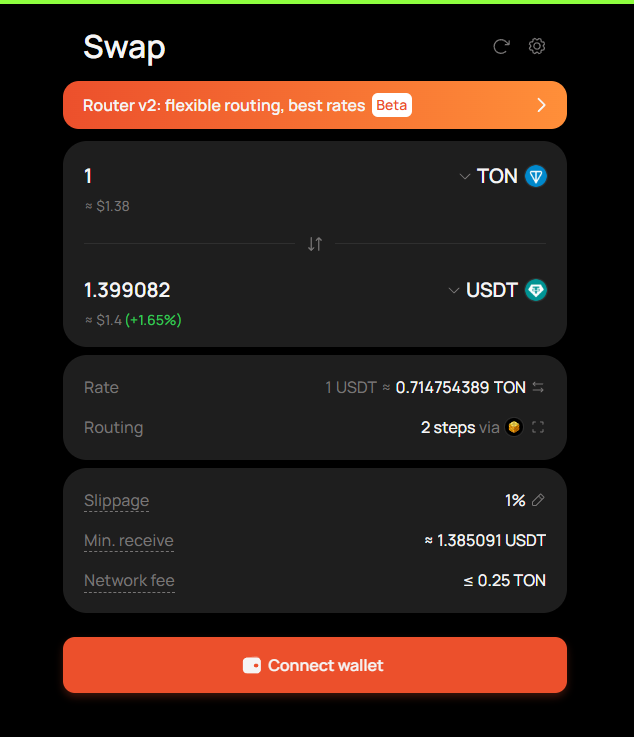
Practical tip: set slippage tolerance to 0.5% for stable pairs (TON/USDT) and 2–5% for volatile ones (memecoins). Too low — the transaction won't go through. Too high — you lose on slippage.
DeDust Fee Structure
| Operation | DEX Fee | Network Fee |
|---|---|---|
| Standard swap | 0.3% | ~0.01–0.05 TON |
| Stable swap | 0.05% | ~0.01–0.03 TON |
| Adding LP | 0% | ~0.05–0.10 TON |
| Removing LP | 0% | ~0.05–0.10 TON |
Of the 0.3% standard swap fee: 0.25% goes to liquidity providers (that's you, if you're an LP), and 0.05% goes to the protocol.
STON.fi: The Main Competitor with a UX Focus
Overview
STON.fi is the second-largest DEX on TON with TVL around $305M. However, in trading volume, STON.fi often leads: over $6.8 billion in cumulative volume and 31+ million transactions since launch. The difference is that STON.fi attracts more active traders, while DeDust attracts more LP providers.
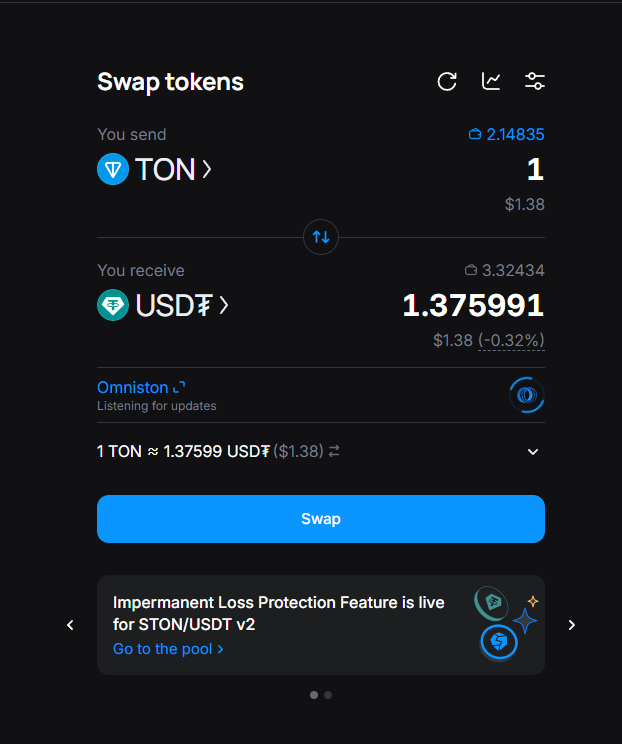
How STON.fi differs from DeDust:
- 6 pool types — constant product, stableswap, weighted constant product, weighted stableswap, single-sided LP, vault-based accounting. DeDust uses standard constant product and stable swap
- Impermanent Loss protection — STON.fi is the first DEX on TON with an IL compensation program for liquidity providers, operational since late 2025
- Single-sided LP — add liquidity with just one token, no need to hold both sides of the pair. The protocol balances the position automatically
- Developer SDK — ready-made libraries for integrating swaps into Telegram bots and Mini Apps
STON.fi Fee Structure
| Operation | DEX Fee | Distribution |
|---|---|---|
| Standard swap | 0.3% | 0.2% → LP providers, 0.1% → STON.fi |
| Network fee (swap) | — | ~0.13 TON |
| Adding LP | 0% | ~0.10–0.13 TON (network) |
| Removing LP | 0% | ~0.10 TON (network) |
Note the fee distribution difference from DeDust. On STON.fi, LP providers receive 0.2% (out of 0.3%), while on DeDust they receive 0.25%. This means that at equal trading volumes, LP income on DeDust is 25% higher.
DeDust vs STON.fi: An Honest Comparison
I use both DEXes regularly, and here is my takeaway — they are not interchangeable; each has distinct strengths:
| Parameter | DeDust | STON.fi |
|---|---|---|
| TVL | ~$379M | ~$305M |
| Trading volume | High | Very high ($6.8B+ cumulative) |
| Number of pools | 600+ | 400+ |
| Pool types | 2 (standard, stable) | 6 (including single-sided) |
| LP fee share | 0.25% of swap | 0.20% of swap |
| IL protection | No | Yes (compensation program) |
| Bridges | Ethereum (WBTC, USDC, DAI) | Ethereum + BTC/ETH cross-chain |
| Telegram Mini App | Yes | Yes |
| Multi-hop routing | Yes | Yes |
| Native token | No (as of Feb 2026) | No (as of Feb 2026) |
When to Use DeDust
- Providing liquidity (higher fee share for LPs: 0.25% vs 0.20%)
- Stablecoin swaps (reduced 0.05% fee for stable pools)
- Trading niche Jetton tokens (more pools available)
- Cross-chain operations via bridges
When to Use STON.fi
- Active trading (typically better liquidity in major pairs)
- Single-token LP deposits (single-sided liquidity)
- Impermanent loss concerns (compensation program available)
- Integrating swaps into your own Telegram bot (SDK)
My approach: for daily swaps, I use STON.fi — usually better rates on major pairs. For LP positions, I prefer DeDust — higher fee share for providers.
Liquidity Provision: How to Earn in DeFi
How LP (Liquidity Providing) Works
When you "provide liquidity," you deposit a pair of tokens into a pool (e.g., TON + USDT) in equal value proportions. These tokens are used to facilitate swaps by other users. For each swap through your pool, you earn a share of the fee proportional to your share of the pool.
Example:
- You deposit $1,000 into the TON/USDT pool on DeDust ($500 in TON + $500 in USDT)
- Total pool size: $100,000
- Your share: 1%
- Daily trading volume through the pool: $200,000
- Pool fee: 0.3% = $600 per day
- LP share: 0.25% = $500 per day (on DeDust)
- Your daily income: $500 × 1% = $5
That's $5 per day on $1,000 — 182% APY. Sounds incredible? Because this is a high-volume example. In practice, volumes fluctuate, and realistic APY ranges from 5–30% annually for stable pools to 20–100%+ for volatile pairs, with proportionally higher risks.
Step-by-Step: Adding Liquidity on DeDust
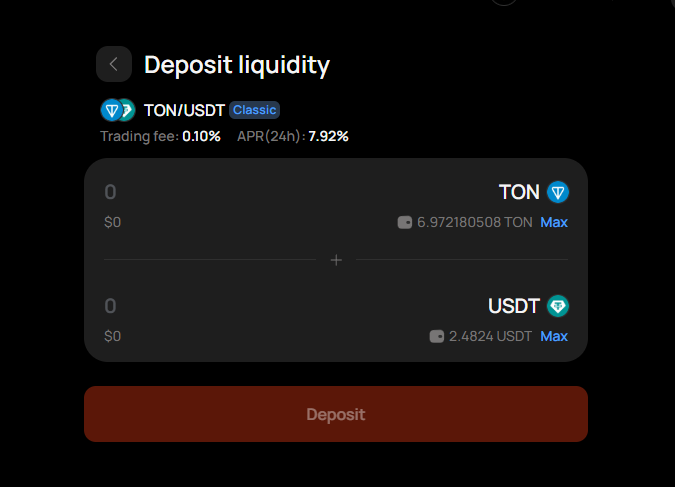
- Open DeDust.io and connect your wallet
- Go to “Pools”
- Select the pair (e.g., TON/USDT)
- Enter the amount for one token — the second is calculated automatically based on the current ratio
- Review details: your future pool share, expected APY
- Confirm the transaction — you'll receive LP tokens representing your share
- Done — fees accrue automatically
Step-by-Step: Adding Liquidity on STON.fi
STON.fi offers an additional option — single-sided LP:
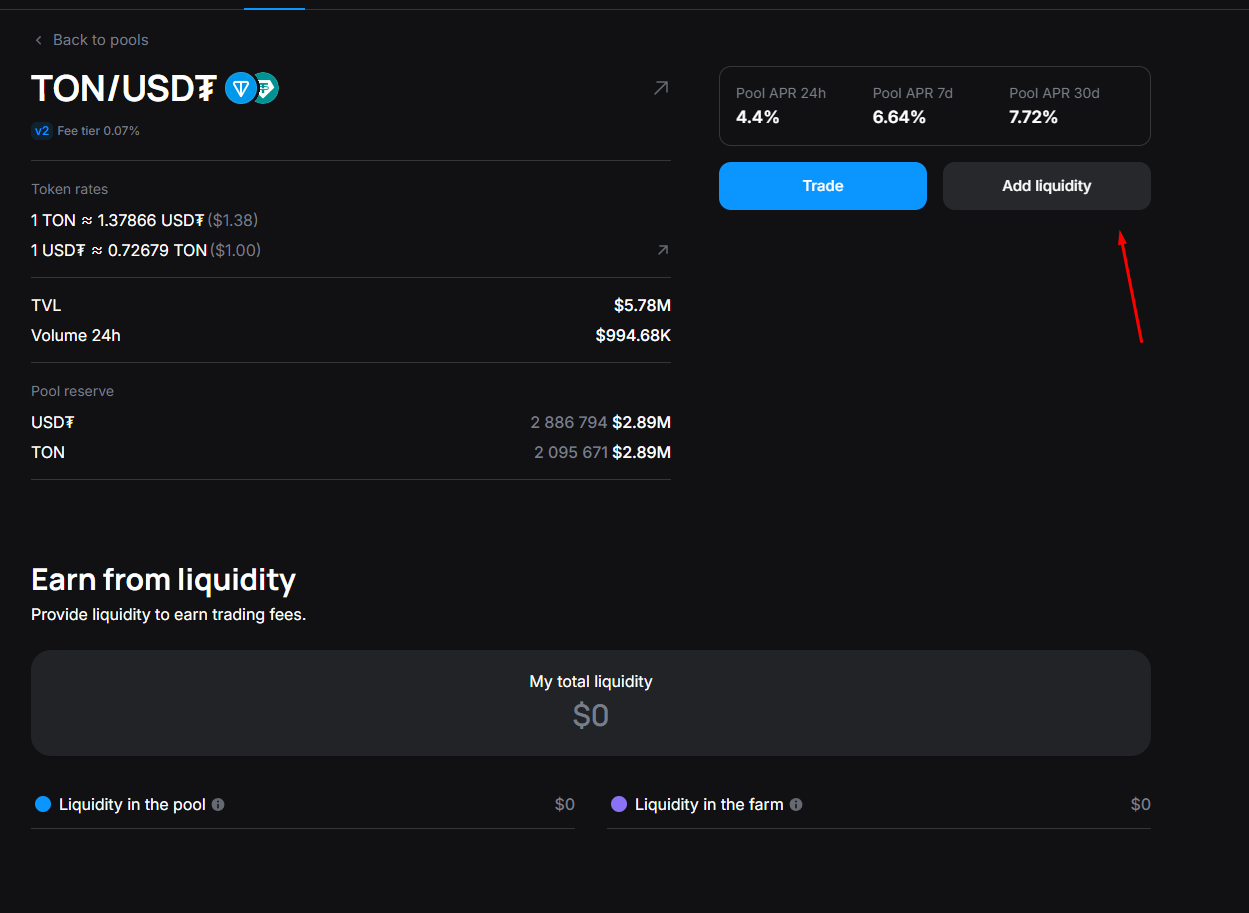
- Open ston.fi and connect your wallet
- Go to "Pools" → select a pool
- Choose mode: "Balanced" (both tokens) or "Single-sided" (one token)
- If single-sided: deposit only TON — the protocol automatically converts half to the paired token
- Confirm the transaction
Single-sided LP is convenient when you only hold one token and don't want to make a separate swap. But note: the internal conversion also incurs a fee, and the effective rate may be slightly worse than a manual swap.
Impermanent Loss: The Main LP Risk
Impermanent Loss (IL) is the difference between what you would have earned simply holding your tokens and what you actually receive when withdrawing liquidity from a pool. IL occurs when the price of one token in the pair changes relative to the other.
IL math with real-world scenarios:
| TON Price Change | IL (vs holding) | Your LP Portfolio | If You Had Just Held |
|---|---|---|---|
| +25% | -0.6% | $1,118 | $1,125 |
| +50% | -2.0% | $1,225 | $1,250 |
| +100% (2x) | -5.7% | $1,414 | $1,500 |
| +300% (4x) | -20.0% | $2,000 | $2,500 |
| -50% | -5.7% | $707 | $750 |
| -75% | -13.4% | $500 | $625 |
Key takeaway: IL only becomes a real problem with large price movements. For fluctuations under 25%, IL is less than 1% — easily covered by trading fees. If you believe TON will 4x, LP is not the best strategy: you'd lose 20% of potential gains.
How to minimize IL:
- Choose stable pairs — the USDT/USDC pool has IL near zero
- Correlated asset pairs — TON/stTON or TON/tsTON: both assets move in the same direction
- Use STON.fi's IL protection — their compensation program covers a portion of losses
- Do the math — if pool fees exceed IL, you're profitable even with losses
Liquid Staking: Passive Income with Flexibility
Regular Staking vs Liquid Staking
Regular TON staking requires a minimum of 300,000 TON to run a validator (realistically ~700,000 TON to get into the top 400). That's $900K+ — not for everyday users. Even staking pools require locking funds for the entire validation period.
Liquid Staking solves both problems:
- Minimum from 1 TON — no thresholds of hundreds of thousands
- Liquidity is not frozen — you receive an LST token (tsTON or stTON) that you can use in DeFi
- Auto-compounding — rewards are reinvested automatically, up to 487 times per year with Tonstakers
Top Liquid Staking Protocols on TON
Tonstakers (tsTON)
- TVL: 70M+ TON (~$233M)
- Users: 100,000+
- APY: ~4.7–5.0%
- Minimum: 1 TON
- How it works: deposit TON → receive tsTON → tsTON appreciates against TON as rewards accrue
Tonstakers is the largest liquid staking protocol on TON with over 70% market share. tsTON is accepted as collateral on DeDust and STON.fi, allowing you to earn staking yield AND LP fees simultaneously.
Bemo (stTON)
- Integration: Telegram Mini App
- APY: ~4.5–4.8%
- Minimum: 1 TON
- How it works: similar to Tonstakers, but focused on mobile UX through Telegram
The "Double Yield" Strategy: Staking + LP
This is where TON DeFi gets genuinely interesting. You can:
- Stake TON → receive tsTON (APY ~5%)
- Deposit tsTON + USDT into an LP pool on DeDust (APY ~10–20%)
- Total: ~15–25% annually instead of 5%
This works because tsTON continues accumulating staking rewards even while sitting in an LP pool. You are literally earning yield on two layers.
Double yield risks:
- IL still applies (tsTON/USDT pair is volatile, same as TON/USDT)
- Two layers of smart contract risk (Tonstakers + DeDust/STON.fi)
- Emergency exit requires two actions instead of one
DeFi Channels in Our Catalog
Our catalog includes over 480 channels in the DeFi category, tracking protocols, new pools, APY updates, and earning strategies. Additional relevant categories:
- Cryptocurrencies — 73,000+ channels, including the largest crypto communities
- Farming — 40+ channels covering airdrops and farming, often with DeFi overlap
- Crypto news — 1,725 channels with news, including DeFi updates
Use our catalog to vet channels before subscribing: we display creation date, subscriber count, posting frequency, and other metrics that help distinguish expert channels from empty shells.
DeFi Strategies by Experience Level
Beginner: First Steps (Capital $50–200)
- Buy TON via @Wallet in Telegram (supports cards, P2P, cross-chain deposits)
- Try a swap on DeDust or STON.fi: exchange 5 TON for USDT and back. Get comfortable with the interface
- Stake 80% of your TON via Tonstakers (tsTON) — the safest strategy at ~5% APY
- Keep 20% for experimenting with swaps
For wallet setup details, see our TON wallet guide.
Expected return: 5–7% annually. On $200, that's $10–14 per year. You won't get rich, but you'll gain experience without significant risk.
Intermediate: LP Strategy (Capital $500–2,000)
- Stake 40% into tsTON (base yield ~5%)
- Add 40% to TON/USDT LP on DeDust (APY 10–30% depending on volume)
- Keep 20% in TON as a reserve for rebalancing and new opportunities
- Check weekly — monitor APY and the status of your LP positions
Expected return: 10–18% annually. IL risk is moderate: TON/USDT is one of the most liquid pairs.
Advanced: Multi-Protocol Strategy (Capital $2,000+)
- Stake 30% through tsTON
- Add tsTON/USDT LP on DeDust (double yield: staking + fees)
- Add TON/USDT LP on STON.fi (protocol diversification, IL protection)
- Allocate 10% to niche pools with high APY (memecoins, new tokens) — high risk, high reward
- Monitor daily — rebalance during significant price movements
Expected return: 15–30% annually with active management. But time investment is higher: 2–3 hours per week on monitoring and rebalancing.
With any strategy, remember: DeFi yields are not guaranteed. APY can drop when trading volumes decline, tokens can lose value, and smart contracts may contain vulnerabilities. More on risks in our crypto scams guide.
DeFi Security Checklist
DeFi is a YMYL (Your Money Your Life) domain. A mistake can cost you all your funds. Here is the minimum set of rules:
Before Interacting with Any Protocol
- The protocol has been operating for more than 6 months without major incidents
- Smart contracts have been audited (check on ton.org/dev)
- TVL is stable or growing (a sharp TVL drop is a red flag)
- Contract code is open-source
Before Adding Liquidity
- You understand both tokens in the pair
- You've calculated worst-case IL if the price drops 50%
- You've confirmed you can withdraw liquidity at any time (no lock-up period)
- You're using a separate wallet, not your main one with large holdings
General Rules
- Never grant unlimited approval — approve only the exact transaction amount
- Don't connect your wallet to unfamiliar dApps
- Regularly check active approvals at tonviewer.com
- Your seed phrase goes to nobody, ever — no legitimate protocol will ask for it
For more on security, see our crypto scams protection guide.
FAQ: Common Questions About DeFi on TON
How much money do I need to get started?
Technically, starting from 1 TON ($3) is possible. Realistically, for meaningful returns, you'll want 50–100 TON ($150–300). Fees on TON are so low (0.01–0.05 TON per operation) that even small amounts aren't eaten by gas, unlike on Ethereum.
Which is better: DeDust or STON.fi?
It depends on your goal. For LP — DeDust (LP share is 0.25% of fees vs 0.20%). For active trading — STON.fi (typically better liquidity in major pairs). For minimizing IL risk — STON.fi (compensation program). See the detailed comparison table above.
What APY is realistic in 2026?
TON staking: 4.5–5% annually. LP on stable pairs: 5–20%. LP on volatile pairs: 20–100%+, but with high IL risk. Promises of "500% APY" are either temporary promotions or scams.
Is providing liquidity safe?
Safer than on most other blockchains: DeDust and STON.fi have been operating for over 2 years without major hacks. But smart contract risk always exists. Rule of thumb: don't invest more in DeFi than you can afford to lose. And diversify across protocols.
Can I lose all my money?
Yes, theoretically. Possible scenarios: smart contract hack (loss of all funds in the pool), token in the pair dropping to zero (loss of half your LP), rug pull by a new protocol. DeDust and STON.fi are mature, audited protocols — hack risk is minimal but not zero.
What is "double yield" through liquid staking + LP?
You stake TON → receive tsTON (which continues earning ~5% APY). Then you deposit tsTON into an LP pool and earn an additional 10–20% from fees. Total: ~15–25% annually. Detailed strategy in the "Liquid Staking" section above.
Where can I follow DeFi news on TON?
Our catalog has over 480 channels in the DeFi category. We also recommend channels in the crypto news category — 1,725+ channels with up-to-date ecosystem news.