










There are hundreds of blockchains. Most of them you have never heard of, and for good reason — they solve problems nobody has, for users who do not exist. TON is not one of them. TON is the only blockchain wired directly into a messenger used by over 1 billion people every month. When we say "wired in," we mean it literally: a wallet inside your chat screen, mini apps that launch with one tap, payments via Telegram Stars — all running on TON under the hood.
We write this from an unusual vantage point. Telegram Store is a catalog of Telegram channels, and at the time of writing, we have indexed over 1.8 million channels. Nearly 20,000 of them are connected to the TON ecosystem — mentioning it in their names, descriptions, or falling into TON-related categories. We see this ecosystem from the inside: tracking audience growth, spotting new projects, and — unfortunately — watching scam channels multiply.
This guide is for anyone who wants to understand what TON actually is, why it is architecturally different from Ethereum and Solana, and how to start using it today. If you have played Hamster Kombat, caught coins in Notcoin, or simply noticed the "Wallet" button in Telegram — you have already touched TON, possibly without realizing it.
What Is TON (The Open Network)?
The origin story: from Durov to the community
TON's history reads like a tech thriller. In 2017, Pavel and Nikolai Durov — the brothers behind Telegram — began building a blockchain for the messenger. Between January and March 2018, Telegram raised $1.7 billion in two private token sales for "Gram" tokens. At the time, it was one of the largest crypto fundraises in history.
Then the SEC stepped in. In October 2019, the U.S. Securities and Exchange Commission filed a complaint alleging that the sale of 2.9 billion Gram tokens constituted an unregistered securities offering. The court sided with the SEC. In May 2020, Pavel Durov announced that Telegram was walking away from TON entirely. The settlement: a $18.5 million fine and $1.22 billion returned to investors.
That could have been the end. But the TON source code had been published under the GNU GPL license, and a group of community developers forked the project. In May 2021, the network went live on mainnet. By August 2021, Telegram had transferred the ton.org domain and GitHub repository to what became the TON Foundation. In December 2021, Pavel Durov himself publicly endorsed the community project — though he was careful to note he had no involvement in running it.
This history matters because it shaped TON's identity: it is a community-governed project, not a corporate product. Telegram integrates TON into its app, but it does not control the blockchain.
What makes TON different
Three things set TON apart from the hundreds of other blockchains:
- Telegram integration. Over 1 billion monthly active users already have the messenger installed. No other blockchain has a built-in distribution channel of this scale.
- Infinite sharding. TON's architecture automatically splits chains into shards when load increases and merges them back when it drops — theoretically scaling to any transaction volume.
- Asynchronous smart contracts. Unlike Ethereum, where contract calls are synchronous, TON contracts communicate via messages and process in parallel. This is a fundamental architectural difference that enables massive concurrency.
Key metrics (February 2026)
| Metric | Value |
|---|---|
| Current TPS | ~16.5 TPS (real-world mainnet) |
| Max TPS (test) | 104,715 TPS (CertiK-verified, October 2023 testnet) |
| Validators | ~350–384 |
| Total stake | ~$933M |
| Toncoin price | ~$1.34–$1.51 (at time of writing) |
| Market cap | ~$3.3–$3.7B |
| Average tx fee | 0.0055 TON (~$0.007) |
| Block time | ~5 seconds |
| Finality | <6 seconds |
| Daily active addresses | ~500,000 (approximate) |
| Daily transactions | ~2M |
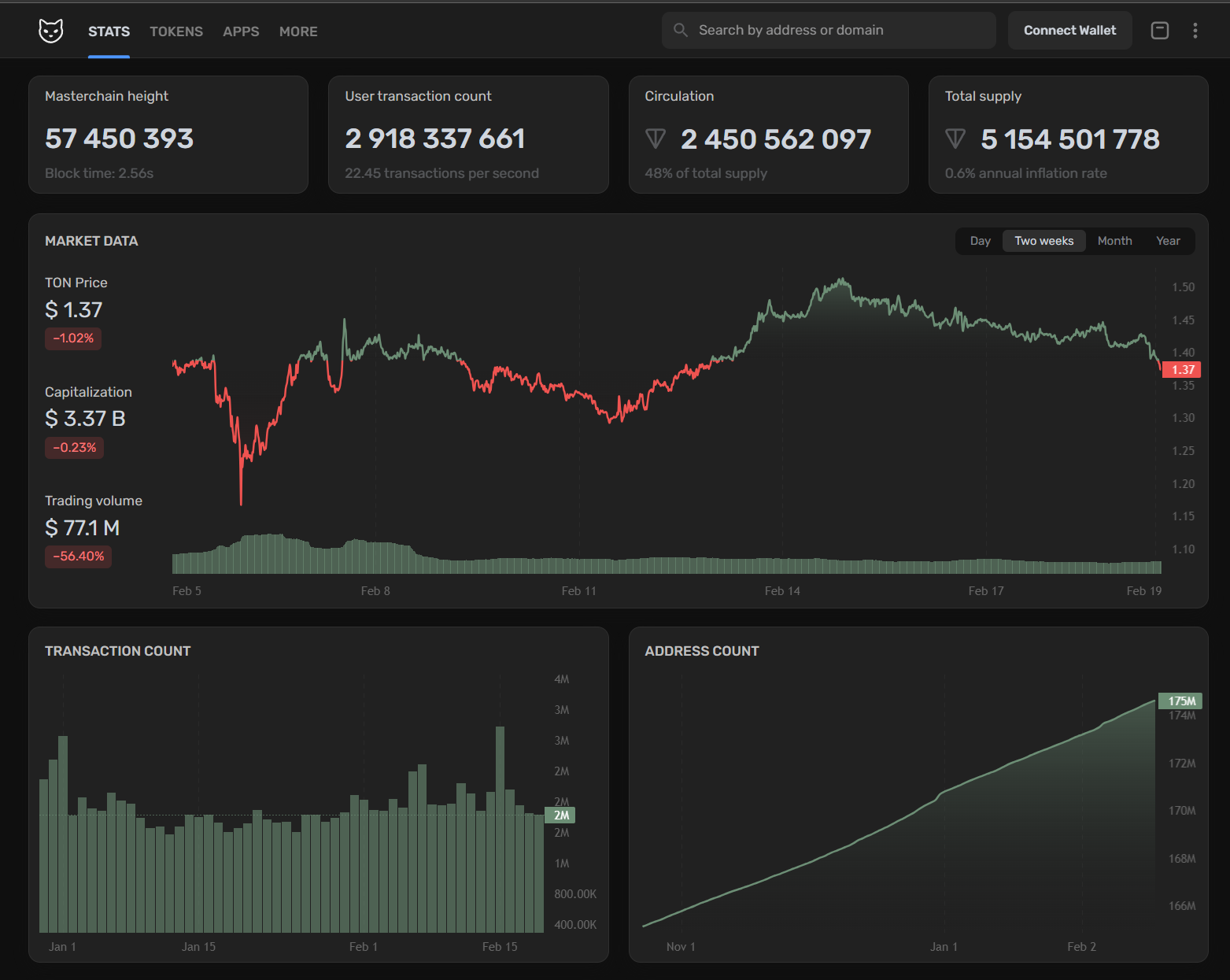
The numbers that matter most here are not the theoretical TPS or block time — it is the 500,000 daily active addresses and ~2 million daily transactions. These indicate real usage, not marketing claims.
How TON Works: Architecture Simplified
If you just want to use TON, feel free to skip this section. But if you want to understand why TON is architecturally different from other blockchains, here is the simplified version.
Three layers: Masterchain, Workchains, Shardchains
TON is not a single chain. It is a hierarchical system of three layers:
- Masterchain — the primary chain storing network configuration and the final state of all workchains. Validator lists, stakes, shard configurations — it all lives here. Blocks are produced roughly every 5 seconds.
- Workchains — up to 2^32 customizable blockchains, each with its own rules and virtual machines. Currently only one workchain (basechain, workchain 0) is active, but the architecture allows adding more.
- Shardchains — dynamic subdivisions of workchains. When load on a shard exceeds a threshold, it automatically splits into two. When load drops, shards merge back. This is the “infinite sharding paradigm.”
Proof-of-Stake consensus
Validators stake Toncoin to participate in block production. The network currently has ~350–384 validators with a Nakamoto coefficient of 84 — meaning 84 validators would need to collude to attack the network. That is a decent level of decentralization, though far from Ethereum's 1 million+ validators.
An interesting property of TON: adding validators increases network performance rather than decreasing it, which is a theoretical advantage of its sharding architecture.
Smart contract languages
| Language | Description | Status |
|---|---|---|
| FunC | Low-level functional language for TVM (TON Virtual Machine) | Legacy, still supported |
| Tact | Higher-level language, compiles to FunC | Primary recommended |
| Tolk | Newest language with expressive syntax and built-in serialization | Emerging |
Development, testing, and deployment use the Blueprint framework, which supports all three languages.
TON vs Ethereum vs Solana
| Parameter | TON | Ethereum | Solana |
|---|---|---|---|
| Consensus | PoS (BFT) | PoS (Casper FFG) | PoS + PoH |
| Real-world TPS | ~16 | 15–20 (L1) | 2,000–5,000 |
| Max tested TPS | 104,715 (testnet) | ~15–30 (L1) | ~65,000 (theoretical) |
| Average tx fee | ~$0.007 | $0.10–$0.32 | ~$0.00025 |
| Block time | ~5 sec | ~12 sec | ~0.4 sec |
| Finality | <6 sec | 12–15 min | ~12–13 sec |
| Smart contracts | Tact, Tolk, FunC | Solidity, Vyper | Rust, C, C++ |
| Sharding | Dynamic (infinite) | Danksharding (planned) | None |
| DeFi TVL | ~$200–300M | ~$55–70B | ~$9–10B |
| Validators | ~350–384 | 1M+ | ~900–1,500 |
| Key advantage | 1B+ Telegram users | Largest DeFi ecosystem | Highest real-world throughput |
The takeaway? TON loses on current real-world TPS and DeFi ecosystem size. It wins on finality (under 6 seconds — fastest of the three) and, critically, on potential reach. Neither Ethereum nor Solana has a messenger with a billion users behind it.
The TON Ecosystem: Projects That Matter
DeFi
STON.fi — the leading DEX
STON.fi is the largest decentralized exchange on TON by volume. Cumulative trading volume exceeds $6.8 billion across more than 31 million operations.
In February 2026, STON.fi took a major step: through the Omniston protocol, cross-chain swaps to WETH and cbBTC became available from any TON-native token. This means TON users can now exchange tokens for Bitcoin and Ethereum without intermediaries.
DeDust — the second major DEX
DeDust leverages TON's sharding paradigm fully, making it one of the most potentially scalable AMMs. Standard swap fee: 0.3%. DeDust data is now live on TradingView.
Omniston — liquidity aggregation
Built by the STON.fi team, Omniston acts as a single entry point scanning all liquidity pools across TON DEXes and routing trades for best rates with minimal slippage. Escrow contracts are audited.
NFT and digital assets
Getgems — the NFT marketplace
Getgems is the largest NFT marketplace on TON. Commission: 5% per sale plus minimal gas. It supports NFT art, Telegram usernames, anonymous numbers, animated gifts, and collectible domains. No KYC required — unlike Fragment.
Fragment — Telegram's own platform
Fragment, operated by the Telegram team, specializes in TON DNS domains, Telegram usernames, and anonymous phone numbers. Trading volume: over 96 million TON (approximately $480M at historical prices). Since late November 2024, KYC is mandatory on Fragment.
A fact many people miss: Telegram usernames and anonymous phone numbers are NFTs on the TON blockchain. When you buy a username on Fragment, you own an NFT.
Wallets
Three wallets serve three different audiences in the TON ecosystem:
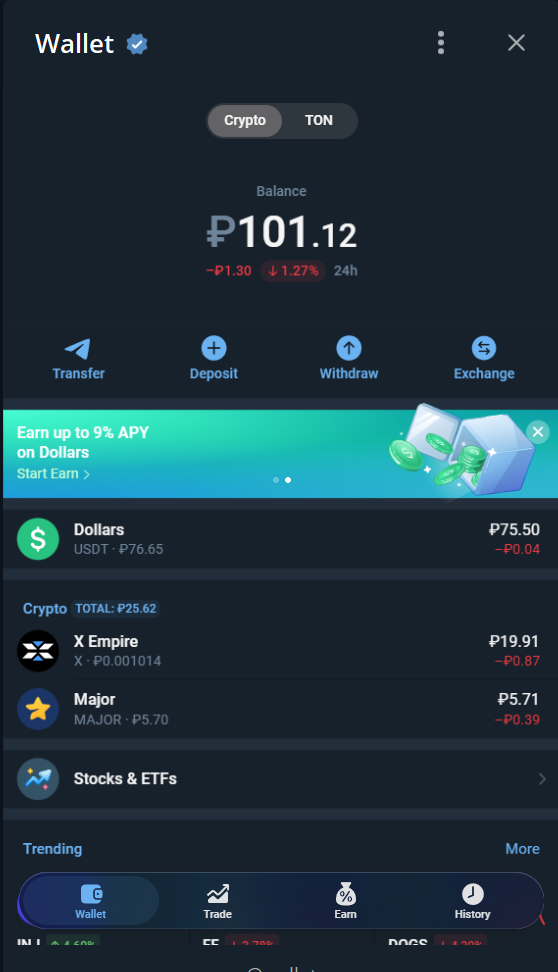
@Wallet (Wallet in Telegram) — a custodial wallet built directly into Telegram. Over 100 million users. As of February 11, 2026, it supports cross-chain deposits of USDC/USDT from Ethereum, Solana, TRON, BSC, Polygon, Arbitrum, and Base — converted 1:1 to USDT on TON. Perfect for beginners.
Tonkeeper — the most popular non-custodial TON wallet. 30+ million monthly active users. Available on iOS, Android, web, and browser extensions. Built-in DEX, staking, dApp browser, NFT management. The Battery feature provides gasless transactions.
MyTonWallet — an open-source, CertiK-audited non-custodial wallet with 9M+ users. Available on the most platforms of any TON wallet. Best choice for users who want to verify the code managing their funds.
Mini Apps and Tap-to-Earn
Mini apps are arguably the most visible vector of TON's mass adoption. According to our catalog data, the top 14 mini app channels collectively have over 230 million subscribers (with audience overlap).
| App | Subscribers | Description |
|---|---|---|
| Hamster Kombat | 31.5M | Largest tap-to-earn game; reached 300M+ users at peak in mid-2024 |
| Blum | 23.4M | Hybrid exchange mini app |
| TapSwap | 16.4M | Tap-to-earn with DEX features |
| MemeFi | 13.9M | Meme-themed tap-to-earn |
| Notcoin | 12.6M | Pioneer tap-to-earn on TON, launched NOT token |
The tap-to-earn frenzy peaked in mid-2024 and activity has since cooled. But mini apps remain the primary hook through which ordinary Telegram users encounter the TON blockchain for the first time.
Infrastructure: TON DNS, Storage, and Proxy
TON DNS — NFT-based ".ton" domain names that replace long wallet addresses with human-readable names (e.g., alice.ton). Similar to Ethereum's ENS. Domains are traded on Fragment and Getgems. TON DNS domains can point to wallets, smart contracts, or TON Sites, making them far more versatile than simple name resolution.
TON Storage — a distributed file storage system using TON's P2P network. Smart contracts manage data distribution across nodes, ensuring redundancy and integrity. TON Storage powers TON Sites — decentralized, censorship-resistant websites with mandatory encryption. Think of it as a BitTorrent-like system but with blockchain-level guarantees.
TON Proxy — a network protocol for routing ADNL traffic. Proxy 2.0 uses "garlic routing" (similar to Tor but optimized for TON) for enhanced anonymity. Proxy 3.0 integrates DeFi: node operators earn micropayments in Toncoin for providing network services. This creates an economic incentive layer for infrastructure providers that most other blockchains lack.
Toncoin: The Native Cryptocurrency
Tokenomics
| Parameter | Value |
|---|---|
| Initial supply | 5B TON |
| Max supply | 5,153,404,410 TON |
| Circulating supply | 2,446,727,995 TON (~47%) |
| Annual inflation | ~0.6% (validator rewards) |
| Daily issuance | 88,137 TON |
| Daily burn | ~3,140 TON |
One detail worth noting: 98.55% of the initial supply was distributed through Proof-of-Work "Giver" contracts (mining completed June 2022). The team allocation was just 1.45% — one of the fairest distributions in crypto. Most of the supply is already unlocked and circulating — no large cliff unlocks ahead.
Where to buy Toncoin
Toncoin trades on all major centralized exchanges: Binance (largest volume), OKX, Bybit, KuCoin, Gate.io, MEXC, and Coinbase. In August 2025, Coinbase Ventures became a Toncoin holder, and Binance integrated Toncoin staking into Wallet Earn.
The simplest method: buy directly through @Wallet in Telegram — no exchange account needed.
Staking overview
| Platform | APY | Minimum |
|---|---|---|
| General staking | 2.4%–4.0% | Varies |
| Ton Whales pools | 4.05%–5.85% | Varies |
| Tonstakers (liquid) | Up to 5% | Low |
| Tonhub pools | ~4%+ | 50 TON |
Staking rates are accurate as of publication date and may fluctuate.
Price context
We deliberately avoid predictions. The facts: Toncoin hit an all-time high of ~$8.24 in June 2024. By February 2026, the price sits around $1.34–$1.51. This kind of drawdown is typical in crypto markets. Any purchase decision should be based on your own research and with full awareness that you could lose your entire investment.
TON and Telegram: The Integration That Changes Everything
This is arguably the most important section of this guide. The Telegram integration is what makes TON a potential game-changer for mass crypto adoption.
@Wallet — a crypto wallet for 1 billion users
@Wallet is a bot built directly into Telegram. Over 100 million people already use it. It operates in two modes:
- Custodial — simple buy, sell, and send. No seed phrase needed. Ideal for beginners.
- Self-custodial (TON Wallet, formerly TON Space) — a full Web3 wallet supporting dApps, NFTs, and DeFi. Your keys, your coins.
On February 11, 2026, @Wallet launched cross-chain deposits: users can now deposit USDC/USDT from Ethereum, Solana, TRON, BSC, Polygon, Arbitrum, and Base. Conversion to USDT on TON happens 1:1, powered by MoonPay.
In our view, this is a turning point. Previously, getting into TON required crypto exchanges or specialized wallets. Now any Telegram user can deposit stablecoins from seven different blockchains without leaving the app.
Telegram Stars
Telegram Stars is an in-app currency for digital content purchases and creator monetization. The key integration: in TON Wallet, you can pay gas fees with Stars — no need to hold Toncoin. This radically lowers the barrier for users who know nothing about crypto.
TON Connect
TON Connect is the authentication and authorization protocol linking dApps with TON wallets. It is the sole protocol for integrating the Telegram Mini Apps ecosystem with the blockchain — TON's equivalent of WalletConnect, but native.
Mini Apps platform
TON is the exclusive blockchain infrastructure for Telegram Mini Apps. This is not a minor detail — it means every mini app that interacts with a blockchain inside Telegram uses TON. With 1 billion+ Telegram users, the distribution potential is enormous.
How to Get Started with TON
Ready to move from reading to doing? Here is your step-by-step plan.
Step 1: Create a wallet
For beginners: Open @Wallet directly in Telegram. It is a bot built into the messenger — nothing to download. Complete verification and your wallet is ready.
For experienced users: Install Tonkeeper — a non-custodial wallet with full control over your private keys.
Step 2: Get Toncoin
Options:
- Buy through @Wallet (simplest method)
- Buy on an exchange (Binance, OKX, Bybit) and transfer to your TON address
- Deposit USDC/USDT from another blockchain via @Wallet (new feature, February 2026)
Step 3: Try DeFi
Start with STON.fi or DeDust — swap a small amount of Toncoin for another token to understand the mechanics. Remember: this always involves risk.
Step 4: Explore mini apps
Open any mini app from Telegram — Hamster Kombat, Notcoin, Blum. It is free and gives you a feel for the platform.
Step 5: Follow the community
For ecosystem news, we recommend:
- @toncoin — official Toncoin channel (9.2M subscribers)
- @tonkeeper_news — Tonkeeper news (6.8M subscribers)
- @stonfidex — STON.fi (1M subscribers)
Risks and What You Need to Know
Scams in Telegram
According to our catalog data, several channels in the "Mining" and "NFT" categories are flagged as [SCAM]. We see channels like "TONIX Community" (1.5M subscribers) and "TreasureNFT" (364K subscribers) marked as fraudulent. Scammers in the TON ecosystem frequently use names similar to official projects.
Be especially cautious with channels promising "free TON," "mine TON via Telegram bot," or "guaranteed staking returns."
Regulatory risks
- SEC precedent: The original token sale was ruled an unregistered securities offering. The current community-led network is a separate entity, but the legal precedent exists.
- Durov legal situation: Pavel Durov was arrested in France in August 2024 on charges related to Telegram platform moderation. The travel ban was lifted in November 2025, but the criminal investigation remains active with no trial date set.
- SEC 2026 agenda: The SEC is pursuing "Project Crypto" with comprehensive rulemakings. New "token taxonomy" and "innovation exemption" frameworks could affect TON positively or negatively.
Network incidents
TON is not flawless in terms of reliability:
- August 2024: 6+ hour outage caused by the DOGS memecoin airdrop — validators could not handle the load. Binance and Bybit suspended TON deposits/withdrawals.
- December 2024: 55-minute degraded service.
- February 2025: 11-minute degraded service.
- March 2025: 22-minute degraded service.
- April 2025: 25-minute degraded service.
- June 2025: ~40-minute outage caused by a masterchain error, requiring validator node restarts.
Similar incidents happen with Solana (which is known for more frequent outages), but for a network aiming to serve billions of users, this track record deserves attention.
Centralization
With ~350–384 validators, TON is less decentralized than Ethereum (1M+ validators) though more than Solana (~900–1,500). There is also the Telegram dependency: if Telegram changes its strategy regarding TON, the ecosystem could be significantly impacted.
Market risks
- Toncoin price dropped from ATH ~$8.24 (June 2024) to ~$1.40 (February 2026) — a decline of over 80%.
- DeFi TVL dropped approximately 61% from peak values.
- The tap-to-earn peak appears to have passed (mid-2024).
- Competition from other L1 blockchains is intensifying.
TON Timeline: Key Events
| Year | Event |
|---|---|
| 2017 | Durov brothers begin building a blockchain for Telegram |
| 2018 | Two token sale rounds raise $1.7B for Gram tokens |
| 2019 | SEC files lawsuit against Telegram |
| 2020 | Telegram ceases TON development. $18.5M fine. Community forks the open-source code |
| 2021 | Mainnet launch. TON Foundation receives ton.org. Durov publicly endorses the community project |
| 2022 | Fragment marketplace launches. Toncoin mining completed |
| 2023 | CertiK verifies 104,715 TPS. TON Grant Program |
| 2024 | Tap-to-earn explosion — Hamster Kombat reaches 300M+ users. Durov arrested in France. 6-hour network outage |
| 2025 | VCs invest $400M+. Libre: $500M tokenized bond fund. Coinbase Ventures becomes holder. Durov travel ban lifted (November) |
| 2026 | @Wallet cross-chain deposits from 7 blockchains. STON.fi opens TON to Bitcoin/Ethereum via Omniston |
Conclusion
TON in 2026 is no longer a startup or an experiment. It is a functioning blockchain platform with hundreds of thousands of daily users, a developing DeFi infrastructure, and — most importantly — native integration with a messenger used by over a billion people.
TON has weaknesses: a relatively small number of validators, a history of network outages, dependence on Telegram's strategy, and a significant decline in Toncoin price. But no other blockchain has such direct access to a mass audience. When your grandmother can send stablecoins through a chat bot — and technically, she already can — that changes the rules of the game.
According to our catalog, the TON ecosystem on Telegram continues to grow: 4,431 channels in the dedicated "TON Ecosystem" category, nearly 20,000 channels mentioning TON. The official Toncoin channel has 9.2 million subscribers. This is a living community that develops independently of the token price.
FAQ
What is TON blockchain?
TON (The Open Network) is a high-performance blockchain designed for integration with Telegram. It uses a multi-level architecture with a masterchain, workchains, and shardchains, enabling up to 104,715 transactions per second (CertiK-verified in a test environment). TON supports smart contracts, DeFi applications, NFTs, and mini apps inside Telegram.
Who created TON?
TON was originally designed by Pavel and Nikolai Durov (creators of Telegram) from 2017 to 2020. After settling with the SEC, the project was continued by community developers. Since 2021, development is managed by the TON Foundation — a non-profit that received the ton.org domain and source code from Telegram.
How to buy Toncoin?
You can buy Toncoin several ways: (1) through the built-in @Wallet in Telegram — the simplest method; (2) on centralized exchanges — Binance, OKX, Bybit, KuCoin, Coinbase; (3) through DEXes on TON — STON.fi or DeDust. Since February 2026, @Wallet also supports deposits of USDC/USDT from seven other blockchains.
Is TON blockchain safe?
TON uses Proof-of-Stake consensus with ~350–384 validators and a Nakamoto coefficient of 84, providing a reasonable level of security. However, the network has experienced outages (including a 6+ hour one in August 2024). The primary risk for users is not the technology itself but scams in Telegram: fake channels, phishing bots, and fraudulent projects. Always verify channel authenticity and never share your seed phrase.
What is the difference between TON and Ethereum?
Key differences: (1) TON uses asynchronous smart contracts (Ethereum uses synchronous); (2) TON supports dynamic sharding (Ethereum is planning Danksharding); (3) TON fees are ~$0.007 vs Ethereum ~$0.10–$0.32; (4) TON finality is <6 sec vs Ethereum 12–15 min; (5) TON is natively integrated with Telegram (1B+ users). Ethereum remains the leader in DeFi TVL ($55–70B vs $200–300M for TON) and validator count (1M+ vs ~350–384).
How to start using TON in Telegram?
The simplest way: (1) open @Wallet in Telegram (search for the bot); (2) complete verification; (3) buy or deposit Toncoin; (4) try a mini app — e.g., @blum or @notcoin; (5) subscribe to @toncoin for ecosystem news.
What are Telegram Mini Apps and how do they relate to TON?
Telegram Mini Apps are web applications that run directly inside the messenger. TON is the exclusive blockchain infrastructure for these apps. Through Mini Apps, users play games (Hamster Kombat, Notcoin), trade on DEXes (Blum), and manage NFTs — all without leaving Telegram. According to our catalog, the top 14 mini app channels on TON collectively have over 230 million subscribers.